September in Edmonton means the River Valley trails are alive with runners chasing distance before the first frost arrives. It also means a familiar tightness beginning to gather at the front of the hip — that deep anterior pull that makes the first kilometre feel like three. If that description resonates, this guide is for you.
Why Fall Running Loads the Hip Flexors Differently
The Capital City Recreation Park trails are beautiful in September, and they are not flat. The rolling terrain of the River Valley asks the hip flexors — the iliopsoas group, the rectus femoris, the tensor fasciae latae — to work harder on inclines and to absorb more load on descents than a road runner on level pavement ever encounters. At the same time, cooler air tends to change how people move: stride length often shortens subtly, cadence quickens, and the body organizes itself slightly differently to conserve warmth. Whether this is a true neuromuscular adaptation or simply a felt shift in comfort is genuinely difficult to say with precision, but the pattern is one many runners and therapists recognize.
What compounds all of this is the desk-to-trail transition that defines most Edmonton runners' Tuesdays and Thursdays. Hours of sitting keep the hip in a flexed position, and while a single workday does not structurally alter muscle length — genuine tissue adaptation unfolds over weeks and months of repeated posture, not a single afternoon — it does affect tone, circulation, and how the tissue feels when you finally lace up at dusk. Stepping straight from a chair onto a hilly trail asks a lot of a hip flexor complex that has spent the day shortened and relatively unloaded.
What Runners in Edmonton Are Actually Feeling
People describe it in several ways: a pulling sensation at the front crease of the hip that sharpens on uphills, a heaviness in the groin that takes two or three kilometres to settle, or a sense that the stride just won't open up no matter how much they warm up. Some notice it radiating into the lower back or down the outer thigh along what Western anatomy describes as the iliotibial complex. Others feel it most acutely in that first step out of the car after a long drive to a trailhead.
That outer-hip and groin connection is worth noting. In traditional Thai medicine, the Sen Kalathari line is understood to travel through the hip, groin, and inner thigh in a way that practitioners have observed for centuries as relevant to leg and lower-back complaints. Whether one reads that as metaphor, as long clinical observation, or as something that maps interestingly onto the Western concept of fascial continuity, it points to the same lived experience: tension in the hip rarely stays in one tidy compartment. Runners feel that interconnection with particular clarity.
“Tension in the hip rarely stays in one tidy compartment — runners feel that interconnection with particular clarity.”
Therapeutic Massage for the Hip: Deep Tissue, Thai, and Myofascial Cupping
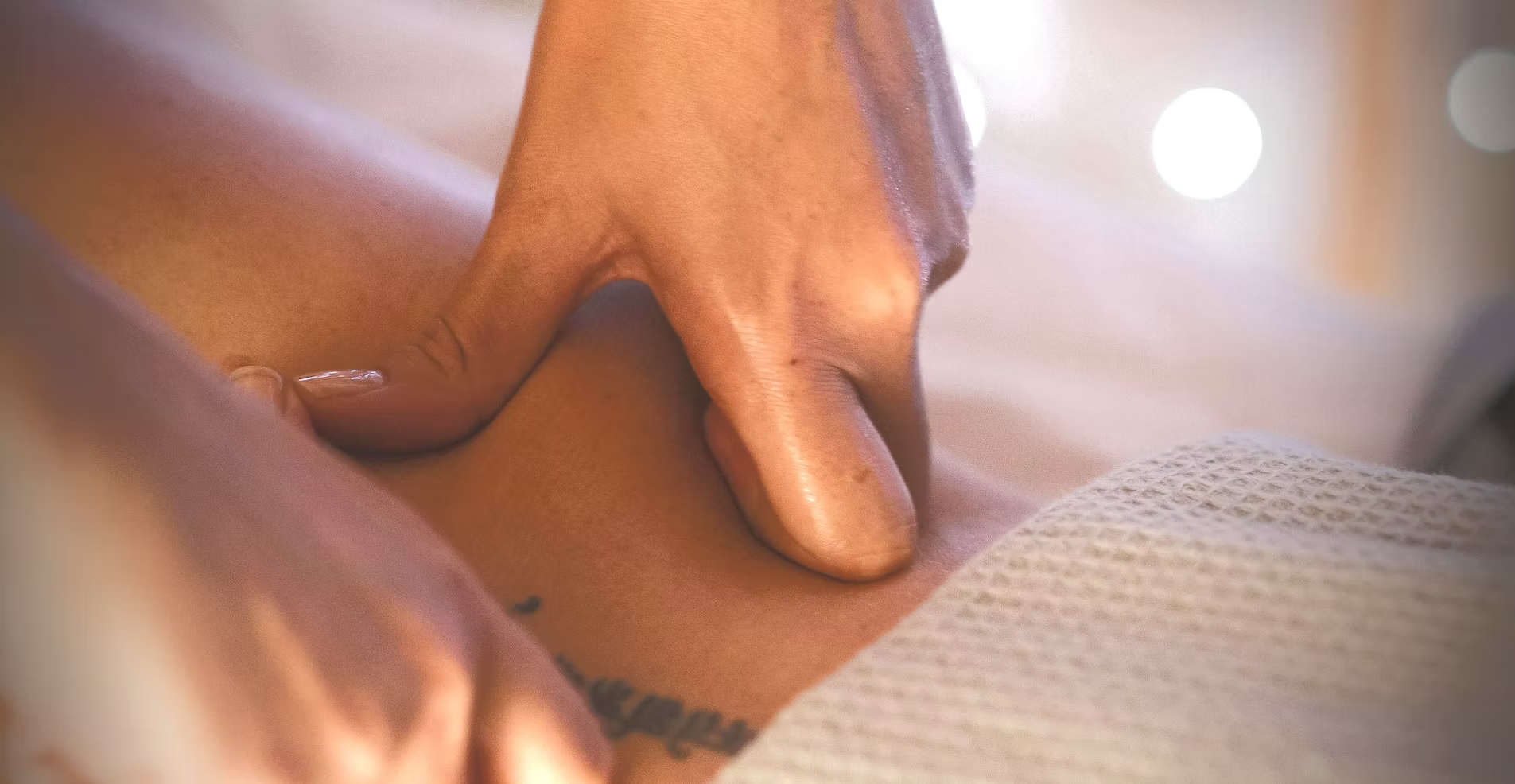
At Thai Healing Hands, we work with the hip and iliotibial complex through three complementary approaches, and for many runners a session draws on more than one. Deep tissue massage applies sustained, considered pressure to the layers of tissue around the hip flexors, the quadratus lumborum, and the outer hip, with the aim of easing the quality of tension that runners consistently describe in those areas. Some clients notice that the tissue feels less guarded and that their range of motion feels freer afterward — though it is worth being clear that a single session addresses tone and how tissue feels in the moment, not structural adaptation, which is a longer-term process.
Traditional Thai massage brings a different quality of attention. Working from the Thai medicine understanding of Sen lines as energetic pathways that organize the body's functional connections, practitioners work along the paths associated with the hip, groin, and lumbar region using rhythmic compression and assisted stretching. Whether you engage with the Sen-line model as a literal energetic framework or as a time-tested observational system for where tension tends to gather and how it tends to travel, many runners find the assisted stretching component particularly useful for that sense of a stride that won't fully open.
Myofascial cupping uses negative pressure rather than compression, creating a lifting effect in the superficial tissue layers over the outer hip and thigh. Practitioners observe that the skin and tissue respond differently to this decompressive approach than to direct pressure, and some clients describe a lasting sense of ease in areas that feel persistently dense or restricted. It is one more lens — neither cupping nor any other modality is presented here as a cure or a structural fix, but as part of a considered therapeutic conversation between therapist and runner.
Pairing Massage With Your September Training Plan
Timing matters, and there is no single right answer — your RMT is the best person to help you think through what makes sense for your body and your schedule. That said, a few general principles are worth considering. Many runners find that scheduling a session on a rest day or low-intensity day, rather than the evening before a long effort, gives the tissue time to settle and allows them to move through the next training day without any post-treatment soreness interfering. During a taper week, some clients choose a lighter, more integrative session rather than deep therapeutic work, prioritizing how they feel on race day over any longer-term tissue conversation.
If you are running consistently through September and into October, a regular massage practice — weekly or biweekly, sustained over the season — is more likely to be meaningful than a single visit. The cumulative effect of repeated, attentive therapeutic work is where practitioners observe the most consistent feedback from clients over time. We warmly encourage you to bring your training log, your race calendar, and your honest account of where things feel stuck to your appointment at our 13819 127 Street NW location, and to treat the intake conversation as genuinely collaborative.
If the anterior hip tightness that comes with Edmonton's fall running season is something you recognize in your own body, we would be glad to talk through what a therapeutic approach might look like for you. Jane and the team at Thai Healing Hands at 13819 127 Street NW are here to support your running season with care that honours both the tradition of Thai medicine and the rigour of Western therapeutic practice — and that listens, above all, to what you are actually experiencing.
Medical Disclaimer: This article is for informational purposes only and does not constitute medical advice. Please consult a qualified healthcare professional before beginning any new therapeutic treatment.